
What To Expect At the Hospital: Infant Adoption
What happens when an Expectant Parent goes into labor?
We encourage the expectant parent to call the on-call worker when they go into labor. Depending on the circumstances, the on-call worker notifies the family or the family’s worker. This depends on the expectant parent’s birth plan which is developed beforehand. The adoptive family’s case worker will keep the family updates as we have significant updates. During normal business hours, the family’s worker will be communicating with them directly. On evenings and weekends, the on call worker or program director may be communicating with the family until the next business day when their worker is able to tag into supporting the family.
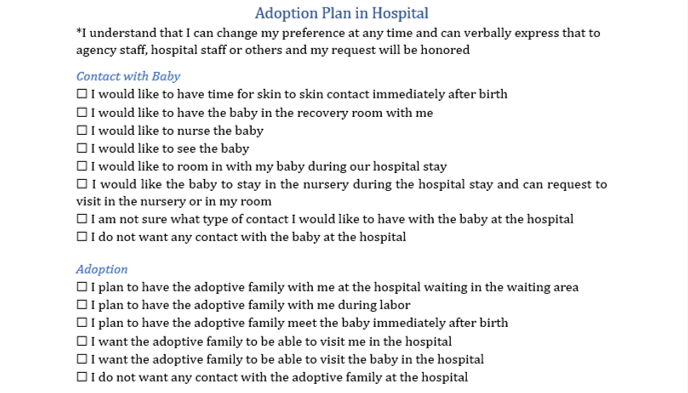
The involvement of the adoptive parents is dependent on the desires of the expectant parents. We discuss this with expecting parents in their birth plan in regards to how involved she may want adoptive parents to be, how much contact she would like to have with baby, or how long they plan to stay with baby in the hospital after birth. Our team does our best to walk expectant parents through different scenarios at the hospital and benefits of post-labor interaction with the baby so that they can make an informed choice. We also send the birth plan to the hospital ahead of time whenever possible. Even the expectant parent’s desired birth plan can change before, during, or after labor which requires a great deal of flexibility and compassion from the adoptive family.
Sample Adoption Plan:
Who makes healthcare decisions for the baby?
Health care decisions depend on if permanent entrustments have been signed. Prior to entrustments being signed, birth parents are legally the only ones you can sign paperwork and consent to or waive medical intervention such as circumcision or shots. Once entrustments are signed, Catholic Charities acts as the legal guardian and can give consent however, will always consult and attempt to honor the adoptive family’s wishes. Hopeful adoptive parents are acting in the role of, and legally considered, foster parents until the legal risk time period has passed.
When will we get to visit the baby?
Visits with baby will depend on the expectant parent’s birth plan. Some birth parents want to spend time with the family and/or want the baby to visit with the adoptive parents, but this can always change once the baby is born. Because their time at the hospital is limited, some birth parents guard it and spend most or all of their time at the hospital with their baby. In some cases, the adoptive family may not see the baby until discharge day. In some cases, families are able to also have a room at the hospital where they can room in with baby or in which baby can go between the birth parent and hopeful adoptive family’s room. This opportunity will vary depending on the birth parents wishes and also the hospital policies regarding adoption.
Our agency advocates for the birth parents wishes regarding contact with baby in the hospital and will be supportive of those expressed wishes, even if those expectations change while at the hospital. This period of post-labor is a sensitive and imperative time for birth parents to have what they feel is needed in order to make a decision regarding what is best for their child. Hopeful adoptive parents should not feel that changes in expectations regarding hospital contact is an indicator of a birth parent(s) changing their mind regarding their decision. It is normal for parents to grieve and waiver in their decision of adoption and they need space to do that without additional pressure.
How long is the hospital stay?
Vaginal birth: usually 2-3 days, discharge planned for 2 days after birth
C-Section: Hospitals usually keep mother for 3 days; discharge can be on day 3 or after
NICU stay: Depends on what hospital is monitoring or what the concerns are about
Baby and birth mother don’t have to be discharged on the same day but they typically do
Note: When appropriate, we will advocate for birth mother to have additional time at the hospital to give her more time with baby and to give her more time to rest and recover after birth prior to signing entrustments.
What do we need in order to be prepared for discharge?
Pediatrician name and contact information
The hospital will need this as well with an appointment confirmation for 2 days after discharge
Car seat
If baby is under 5 lbs 8 oz, the hospital will do a stress test with baby in car seat which can take a couple hours
Bassinette, clothing, diapers, etc. for about one week (rest of legal risk period)
The worker/hospital will share with you the type of formula baby is taking & the hospital will often send you home with extra
If you don’t have a crib yet, get a pack ‘n play with an infant insert, this will serve you well during legal risk
We recommend you have several muslin swaddle blankets on hand as babies love to be swaddled and feel safer when they are
Baby Bottles: you may need a few on hand because the bottles they use at the hospital are very fast flowing and it’s beneficial to acclimate baby to a slower feeds to avoid overfeeding. We also recommend glass or non toxic plastic bottles.
What is Cradle Care versus Direct Placement?
In preparing for adopting an infant, families need to ask themselves “Are we willing to accept placement during legal risk?” This was on your “Child Considerations Form.” Most families are open or willing to discuss. Placement directly with adoptive family is often what the expectations parents want for the baby. We as an agency always work to meet the expectant parents where they are at and strong encourage families to honor the expectant parent’s wishes. You have the right to say “no” to placement during legal risk and this is a concern to bring up with your case worker.
There is always the risk of expectant parent’s changing their mind about placing their child for adoption and deciding to parent instead. We encourage our adoptive families to view the legal risk period as a “foster placement.” The risk of not being open to placement within legal risk is impact on the relationship with the birth parents. It is a possibility that an expectant parent chooses another family if she feels strongly about direct placement with a family.
If we assess that a birth mother is waving in her decision to place for adoption, we may recommend cradle care to allow her space to consider her options and time to make a decision. There is no way to know for certain how a birth parent will respond after leaving the hospital. We try to offer a lot of support and opportunities to process in the days following discharge but families should be prepared for this time of uncertainty.
What we want you to know as an adoptive parent
Flexibility will serve you well
Even though planning is a big part of our services with an expectant parent and adoptive families, plans to change going into the hospital and the days or weeks afterwards
Make it your goal to be flexible, open-handed with plans, and ready for things to change (this starts in managing your expectations mentally!)
Expectant parents are “driving the bus” until legal risk is over
It will feel like it’s not fair and there will be difficult moments of being in the hospital while not fully having the autonomy you want with your adopted child, your worker will be there to support you through this
Shift your mindset to service: how can you think of what is needed for the birth parent to process this loss? Is there anything you can do or not do to further support them?
This time period is short in the grand-scheme of a child’s life, but we understand it is difficult nonetheless
Our Team is here to support you through this time and grateful that you have stepped into this journey of adoption. Be sure to check out this next blog on preparing for discharge and beyond: