
Understanding Your Child's Developmental Stage
You may have heard of Erikson’s stages of development. This theory proposes that there are eight stages of psychosocial development, from infancy to adulthood, that everyone passes through. Each stage is marked by a conflict that must be resolved for healthy personality growth. The stages are outlined below:
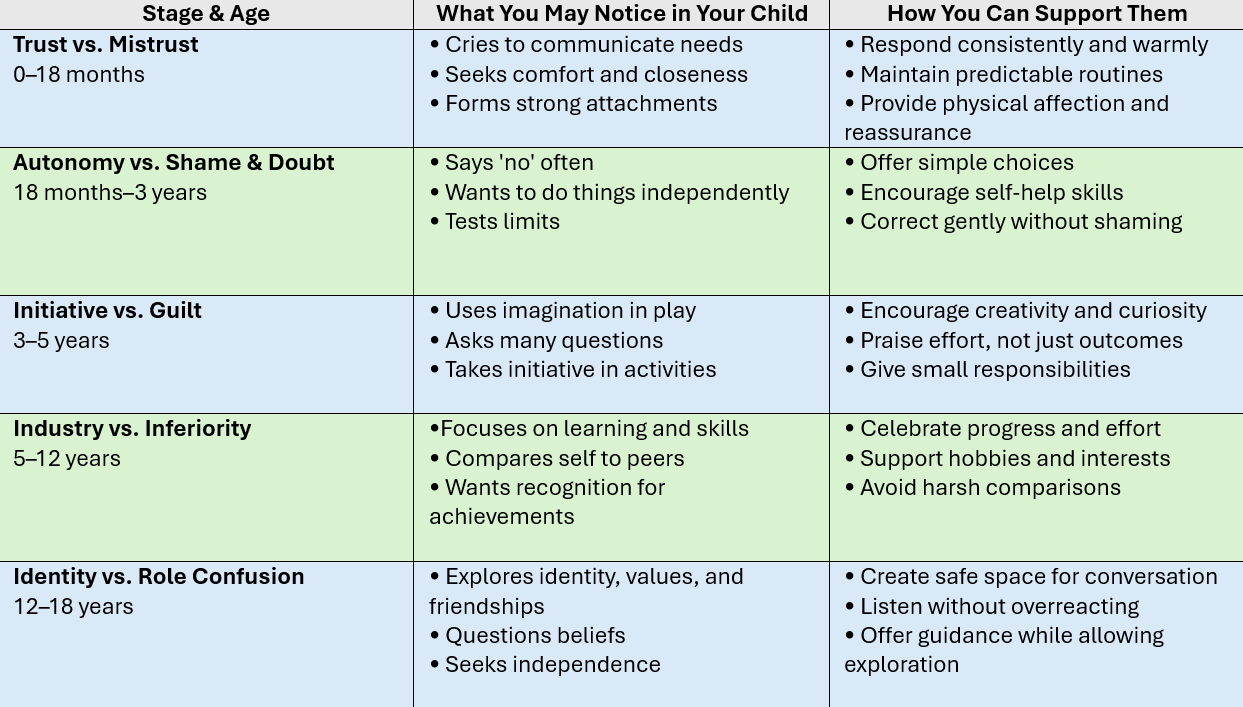
There is increasing research on how trauma affects a person’s ability to go through these stages. Trauma has a significant impact on our brains and development. Having a deeper understanding of the stages of development and how trauma affects them can help you support your adopted child.
To help you form a better understanding, we challenge you to take the ACES to identify any childhood trauma you may have experienced. Then look at Erickson’s stages of development to see what stage of development you were in when trauma occurred. Look at the chart and see if your behavior coincides with any of the behavior for that age and stage. Do you feel that you struggled during that stage? If so, how did this affect the next stages of development?
If you are currently parenting, it is important to consider your child’s past trauma when addressing challenging behaviors. Often, parents focus purely on the behavior and not the reasons or needs behind the behavior. To best support your child, understanding the behavior and providing proper therapy and intervention is key. Looking at Erikson’s stages of development and your child’s past trauma is a great place to start. With the help of a therapist, you can work with your child to revisit a stage and help them to master it.
For more information, please review the following resources:
Erickson's Stages of Development and Adverse Childhood Experiences
Erik Erikson's Stages of Psychosocial Development
Childhood Trauma Effects on the Brain with Bruce Perry